Our new art of Rabbi Akiva, "In Thought"
Where do we even start on Rabbi Akiva? He's the classic rabbi that every Jewish kid first learns about even in the light Hebrew school. If you were to ask the average Jew to list the most famous pre-modern rabbis, he would be at the top of the list, possibly tied with Hillel.
Indeed, you know what's easy to forget? A bunch of the greatest insights on Torah and on life actually come from Rabbi Akiva. We remember the ideas but not the attribution.
"Love your brother as yourself", often phrased as "Love your fellow as yourself" or "Love your fellow Jew as yourself" is one insight we hear rabbis and thinkers and Jews (and for the secularized version) non-Jews repeat over and over. And yes, it was Rabbi Akiva who first observed this, or at least we credit him with doing so.
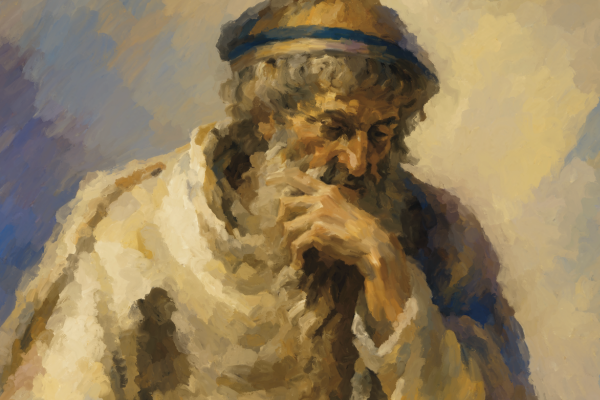
This is why we chose to make this piece of Rabbi Akiva, deep in thought. We imagine him pondering the toughest questions out there, debating with his fellow rabbis - his fellows, whom he surely loved as himself! - and bringing out learning and insight after learning and insight on the Torah.
My personal favorite insight of Rabbi Akiva's is his "Everything is foreseen, yet freedom of choice is granted". This is a concept of his that inspired my core argument in my book Meditations on Forgiveness. It simplifies and clarifies part of the paradox of existence: we can make choices, yet it's already known how everything will turn out. How do we reconcile those two? Rabbi Akiva has a lot to say on that; but, in his shadow and imitation with the tiniest spec of his inspiration, so do I—as you can read in the book.
Part of the visual inspiration for this piece is Rodin's statue Le Penseur, The Thinker. This is the pose of man in thought, although, when I'm thinking, I don't usually put my hand on my chin. I wonder why we represent that visually that way - but for whatever reason, that is the metaphorical language we use to show thought. And we bring that out in this piece.